Jim Clarke
We Have Always Lived in the CastleJim Clarke is a villager whose clearest role is to interrupt the mob’s destruction of the Blackwood house and, later, to approach the sisters after they have shut themselves away. He does not end the villagers’ hostility, but his intervention changes the immediate scene: a crowd laughing at the Blackwoods is made to hear that Julian Blackwood has died, and Jim begins turning people back toward their cars. His later return, with Helen Clarke and Dr. Levy, brings a different pressure—the offer of help, coupled with a plan to take the sisters elsewhere.
Identity and Context
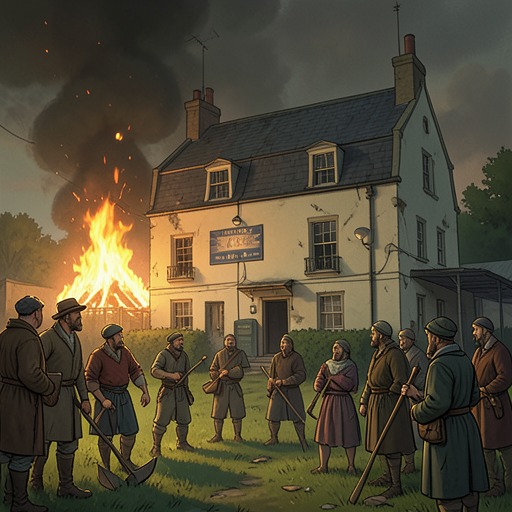
Jim Clarke appears as a member of the village community, but the account gives little biographical detail beyond his actions in two encounters. At the first, he arrives in a car with Helen Clarke while the villagers are inside and around the Blackwood house, breaking windows and throwing out household possessions. Jim gets out and demands to know what is happening. His arrival is not presented as a planned intervention: the cars’ headlights sweep across the lawn, and he finds the disorder already underway.
The stakes of that disorder include the Blackwood family’s private domestic life, now exposed to the crowd. The villagers are throwing dishes, glasses, silverware, and even the pots Constance Blackwood used for cooking. Mary Katherine Blackwood worries that her kitchen stool may have been smashed. Against this destruction, Jim’s first response is direct condemnation. Pushing through the door, he repeatedly calls the people inside crazy and drunk, making plain that he does not join in their celebration of the damage.
Intervention During the Mob’s Attack
Jim moves from protest to an effort to stop the crowd. From the porch, he says, “That’s all now,” then repeats, “That’s enough.” His voice is not loud, but the crowd hears him. The interruption briefly produces a polite silence; then a villager repeats the cruel remark that Julian is “Down in the boneyard ten feet deep,” and laughter rises again. Jim’s authority is therefore neither automatic nor complete: the crowd can still answer his attempt at restraint with mockery.
He then raises his voice and states, “Julian Blackwood is dead.” The announcement changes the atmosphere. Charles Blackwood asks whether Constance killed him, and the villagers withdraw from the sisters, leaving a wide space around them. Dr. Levy, standing in the doorway, answers that Constance did not kill Julian and that he died as the doctor had long expected. Jim does not supply that medical explanation himself; his intervention is to make the death public and then act on its significance.
Jim tells the crowd to go quietly and begins taking people by the shoulders, nudging them toward their cars and the driveway. He urges them to leave quickly because there has been a death in the house. The shift is stark: moments earlier the mob treated the house as a target and Julian’s death as a joke; Jim insists that the death must be recognized as a reason to depart. His physical task of turning people away helps create the opening through which Mary Katherine and Constance can move toward the darkness and the woods. He does not see them as they leave, but his effort to disperse the crowd makes their escape possible in that moment.
Return to the Closed House
Jim appears again when Helen Clarke and Dr. Levy come to the house after the sisters have withdrawn inside. Helen calls for Constance and Mary Katherine, asks them to open the door, and says she wants them to come to her house until a decision can be made about what to do. The sisters remain hidden on the cellar stairs, listening through the closed door. When Helen insists that they must be able to hear her, Jim answers, “I’m sure they can hear you,” adding that they can probably hear her in the village. His reply recognizes how exposed the conversation is, even though the sisters do not respond.
At a later approach to the boarded-up house, Jim again accompanies Helen and Dr. Levy. He remarks that the house is boarded up, while the sisters listen from within and prepare to retreat to the cellar if they are seen. Dr. Levy calls for Miss Blackwood and knocks. Jim’s statement that he is “supposed to bring them home with me” makes the visit’s practical purpose explicit: he has been assigned, or at least expected, to take the women away from the house. The account does not say who gave him that task, and the sisters do not accept the invitation or come out.
Character and Narrative Role
Jim’s actions hold together two forms of response to the Blackwoods. During the attack, he opposes the crowd’s immediate cruelty: he calls the attackers foolish, states the fact of Julian’s death, and physically sends the villagers away. Afterward, he participates in an effort to reach the sisters and remove them from their sealed home. That effort may be intended as assistance, but from the sisters’ hidden position it also means that outsiders are again trying to cross the threshold and determine where they should live.
The contrast is sharpened by the house itself. First, Jim sees it amid broken windows and the crowd’s intrusion; later, he finds it boarded up, with the sisters refusing contact behind closed doors. He can help bring the public violence to a pause, but he cannot make the sisters trust the village or persuade them to accept its proposed refuge. His limited but consequential presence marks the difference between stopping an immediate assault and repairing the isolation that follows it.